Key Takeaways
- 11labs ranks #1 for voice quality and realism, offering the most natural-sounding AI voices with emotional depth and professional-grade output
- The top AI voice generators differ significantly by specialization: 11labs (quality), Minimax (multilingual), RecCloud (video integration), Hume AI (emotional intelligence), Gaga AI (audio-to-video)
- Free AI voice generator options exist on most platforms with 10,000-25,000 character monthly limits suitable for testing and personal projects
- Realistic AI voice generator capabilities now include voice cloning, with top platforms requiring only 1-5 minutes of sample audio to replicate a specific voice
- Pricing ranges from free tiers to $10-100/month for creators, with enterprise custom pricing for high-volume commercial applications
Table of Contents
What Makes a Top AI Voice Generator?
A top AI voice generator delivers broadcast-quality audio that listeners cannot distinguish from human recordings, offers reliable pronunciation across diverse content, and provides flexible controls for customization. The difference between average and top-tier voice AI is immediately apparent when you compare output side-by-side.
Evaluation Criteria for Ranking
The top platforms excel across these five dimensions:
1. Voice Quality & Realism
- Natural prosody (speech rhythm and intonation)
- Emotional range and expression capability
- Absence of robotic artifacts or glitches
- Breath sounds and subtle vocal textures
2. Voice Library & Diversity
- Number of available voices (50+ is standard; 500+ is exceptional)
- Age ranges, accents, and gender options
- Character voice options (dramatic, professional, casual)
- Language and dialect coverage
3. Control & Customization
- Fine-tuning parameters (speed, pitch, emphasis)
- SSML support for advanced control
- Voice cloning capabilities
- Pronunciation dictionary for technical terms
4. Reliability & Performance
- Generation speed (seconds vs. minutes)
- Consistency across multiple generations
- API stability for enterprise applications
- Uptime and service availability
5. Value & Accessibility
- Free tier generosity
- Pricing transparency
- Commercial licensing clarity
- Learning curve and user interface quality
| Rank | Platform | Best For… | Realistic Score | Monthly Free Tier | Price (Starting) |
| #1 | 11labs | Professional Quality | 9.2/10 | 10,000 chars | $5 |
| #2 | Minimax | Multilingual Scale | 8.5/10 | 25,000 chars | $5 |
| #3 | Hume AI | Emotional Nuance | 8.8/10 | 20,000 chars | $3 |
| #4 | Gaga AI | Video/Avatar Sync | 8.8/10 | 50,000 chars | $7.9 |
| #5 | RecCloud | Audio & Video Workflows | 7.8/10 | 15,000 chars | $4 |
#1: 11labs – Best Overall AI Voice Generator
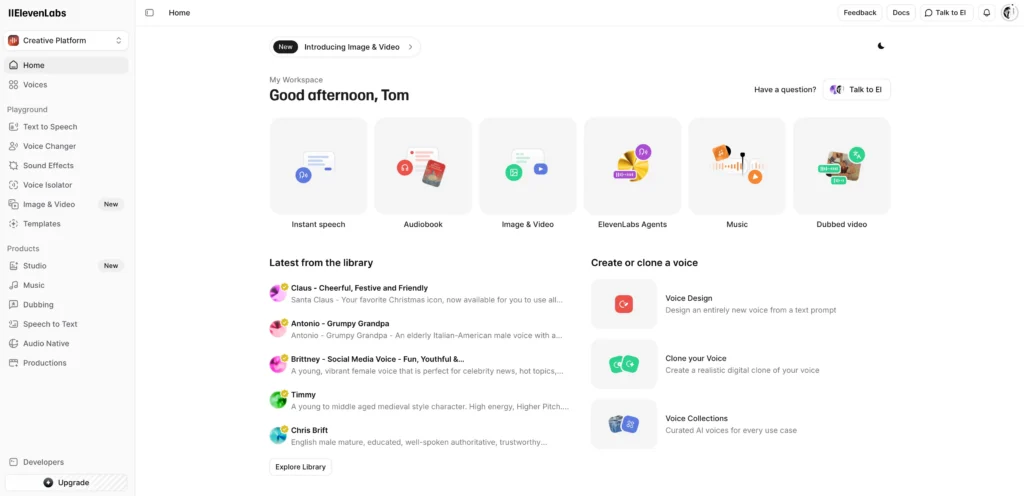
ElevenLabs continues to dominate the 2026 landscape by shifting the benchmark from “lifelike” to “emotionally intelligent.” With the launch of Eleven v3, the platform now masters subtle human nuances like whispering, laughter, and even singing, making it the premier choice for professional-grade media.
Why ElevenLabs Leads in 2026
- The v3 Advantage: Unlike traditional models that focus on clarity, Eleven v3 (Alpha) focuses on expression. It understands contextual cues—automatically inserting giggles, sarcastic inflections, or dramatic pauses based on the text.
- Ultra-Low Latency: The Flash v2.5 model offers 75ms latency, making it the industry leader for real-time conversational AI and interactive agents.
- Voice Diversity: While maintaining a library of 1,000+ voices, it now supports 29+ languages with consistent emotional depth across all of them.
Key Capabilities
- Professional Voice Cloning: Create a high-fidelity “Digital Twin.” While Instant Cloning requires only 1 minute of audio, Professional Voice Cloning (available on Creator+ plans) offers deep-learning replication suitable for Hollywood-caliber dubbing.
- Multimodal Audio Suite: Beyond speech, the platform now includes AI Music Generation (studio-quality tracks with vocals) and Voice Isolator for cleaning up noisy field recordings.
- Conversational Agents: A robust API for developers to build voice bots with advanced “turn-taking” logic and function calling.
Real-World Performance & Use Cases
- Professional Publishing: Used by authors to generate multi-voice audiobooks directly from ePubs/PDFs via the ElevenLabs Studio.
- Global Localization: The Dubbing Studio allows creators to translate video content into 30+ languages while preserving the original speaker’s unique voice.
- Enterprise Scale: Trusted by major entities for call centers, health-tech (HIPAA compliant tiers), and localized marketing.
Updated Pricing Structure (2026)
ElevenLabs uses a “Credit” system where 1 character $\approx$ 1 credit.
| Tier | Monthly Cost | Credits/Month | Voice Cloning | Key Features |
| Free | $0 | 10,000 | No | Try v3, Music, & Agents; no commercial rights. |
| Starter | $5 | 30,000 | Instant | Commercial License included. |
| Creator | $22 | 100,000 | Professional | 192kbps audio; first month 50% off. |
| Pro | $99 | 500,000 | Professional | 44.1kHz PCM (Studio Quality) via API. |
| Business | $1,320 | 11M | 3 Prof. Clones | Low-latency TTS (as low as 5¢/min). |
| Enterprise | Custom | Unlimited | Custom | SSO, BAA (HIPAA), & Priority Support. |
Best For: Professional creators, developers building low-latency apps, and publishers requiring the highest emotional fidelity in the market.
Limitations: The “Free” tier does not include a commercial license or voice cloning; high-volume credits at the Pro/Scale levels require significant monthly investment.
#2: Minimax – Best Multilingual AI Voice Generator
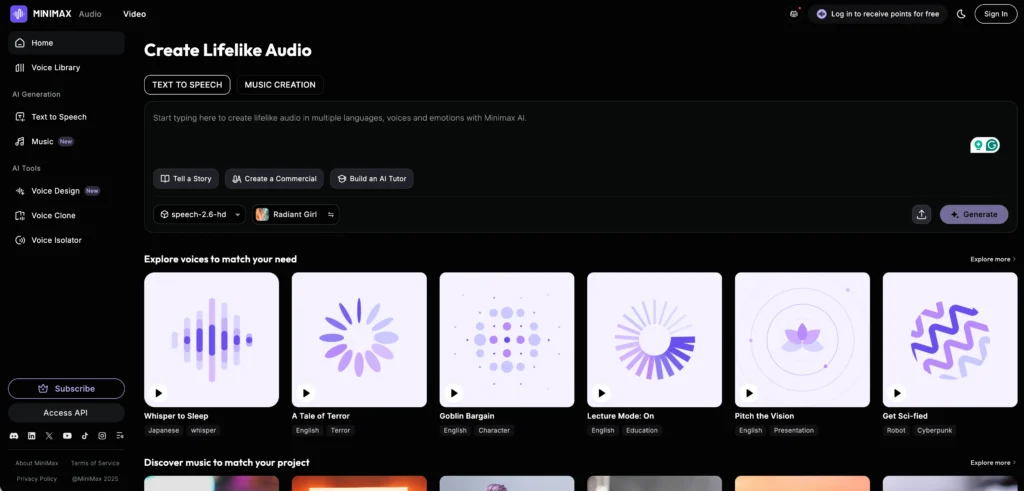
MiniMax is the top choice for interactive AI agents and global brands. While 11labs focuses on narrative depth, MiniMax dominates in responsiveness and cost-efficiency, offering a sub-250ms latency that makes AI-human conversation feel instantaneous.
What’s New in Speech 2.6 (2026 Update)
- Ultra-Low Latency (<250ms): MiniMax has re-engineered its audio pipeline to achieve industry-leading speeds. This eliminates the “lag” typically found in voice assistants, making it the standard for AI customer service and live gaming.
- Fluent LoRA Technology: A breakthrough in voice cloning. Even if your source audio is noisy or contains stutters/disfluencies, Fluent LoRA “repairs” the output, creating a perfectly fluent voice while strictly maintaining your unique vocal timbre.
- Intelligent Format Handling: No more text pre-processing. The model natively understands and reads complex formats like URLs, email addresses, phone numbers, and IP addresses with human-like naturalness (e.g., automatically reading “$1,234.56” as “one thousand two hundred thirty-four dollars…”).
Key Strengths
- Native Multilingual Support: Supports 40+ languages (including tonal languages like Mandarin and Vietnamese) using native-trained models. It excels at “code-switching” (mixing languages mid-sentence) without losing accent authenticity.
- Instant Cloning: Replicate any voice with as little as 10 seconds of audio. Higher tiers allow for up to 250+ custom voice slots.
- Hybrid Model Variants:
- Turbo: Optimized for extreme speed and low cost (perfect for Chatbots).
- HD: Optimized for studio-grade clarity and expressive prosody (perfect for Audiobooks).
Pricing & Value (2026 Tiers)
MiniMax offers significantly more “airtime” per dollar than its premium competitors.
| Tier | Monthly Cost | Credits (Monthly) | Voice Slots | Best For… |
| Free | $0 | 10k + 10k Bonus | 3 | Personal testing/hobbyists. |
| Starter | $5 | 100k + 10k Bonus | 10 | Independent developers & Small projects. |
| Creator | $15 | 250k + 10k Bonus | 30 | Professional creators (approx. 5 hrs audio). |
| Standard | $30 | 600k + 10k Bonus | 50 | Growing startups & High-volume creators. |
| Pro | $99 | 2.2M + 10k Bonus | 250 | Enterprise-level voice agent deployment. |
Note: Credits roughly translate to 1 million credits = $50 (via top-up).
Best for: Real-time AI agents (customer service), international businesses, and developers who need high-performance API integration at a lower cost than 11labs.
Limitations: While the HD model is excellent, its “creative” emotional range (like intense crying or shouting) is still slightly behind ElevenLabs v3 in purely narrative/acting contexts.
#3: RecCloud – Best AI Voice Generator for Video Creators
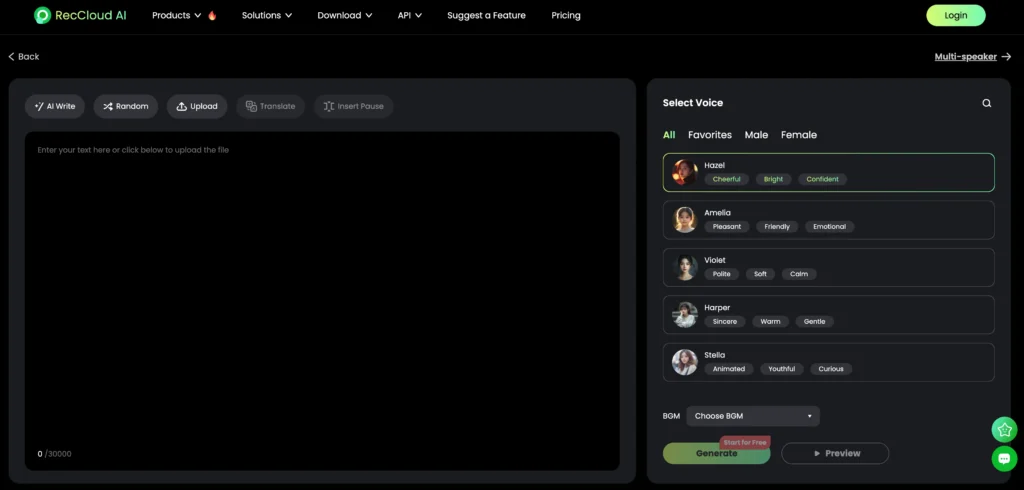
RecCloud is the efficiency leader for video-centric creators. Unlike standalone voice generators, RecCloud’s strength lies in its “horizontal integration,” allowing you to flip a screen recording into a multi-language dubbed video with synchronized subtitles in minutes.
Why RecCloud Dominates Workflows
- The “One-Click” Ecosystem: RecCloud doesn’t just generate audio; it bridges the gap between text and video. You can input a script, generate a voiceover, and immediately use the AI Subtitle Generator to create 98% accurate, time-synced captions.
- Massive Voice Library: Now featuring 500+ lifelike voices (such as ‘Andrew’ for tech reviews or ‘Sophie’ for brand trust) across 100+ languages and accents, including specific regional variations like Australian English.
- Extreme Processing Speed: Optimized for long-form content, it can process 1,000 characters in just 3–5 seconds. Logged-in users can convert up to 30,000 characters in a single batch—enough for an entire audiobook chapter or a long-form documentary script.
Key Video-First Features
- AI Video Translator & Dubbing: Seamlessly translate existing video content into 99+ languages with options for single-voice or multi-voice dubbing that intelligently matches different speakers.
- Integrated Background Music: Layer BGM directly into your voiceover within the platform, saving you from needing external editing software for social ads or explainers.
- Cloud-Based Management: Offers up to 100GB of storage and “My Space” for managing playlists, sharing via QR codes, and collaborating on cross-platform memberships (Web, Windows, iOS, Android).
Updated Pricing & Credit System (2026)
RecCloud uses a flexible credit system where 1 credit = 200 characters for single-voice TTS.
| Plan | Price | Credits & Storage | Best For… |
| Free | $0 | Limited Trial | Quick tests; 2GB storage. |
| Basic (Annual) | $4/mo | 3,000 Credits / Yr | Light hobbyists & students. |
| Pro (Annual) | $5.75/mo | 8,800 Credits / Yr | Most Popular: YouTube & TikTok creators. |
| Business | $27.8/mo | 36,000 Credits / Yr | Batch Processing, 100GB storage, commercial use. |
| Pro (Weekly) | $12.9/wk | 300 Credits / Wk | Short-term, high-intensity projects. |
Note: Credits can also be used for Speech-to-Text (1 credit/min) and Video Translation.
Best For: YouTubers, EdTech startups, and marketing teams who need to produce high volumes of localized video content quickly without hopping between multiple tools.
Limitations: While the voices are “realistic and emotional,” they lack the deep “micro-expression” controls (like forced whispering or specific sarcasm triggers) found in ElevenLabs v3.
#4: Hume AI – The Best for Emotional Intelligence & Agents
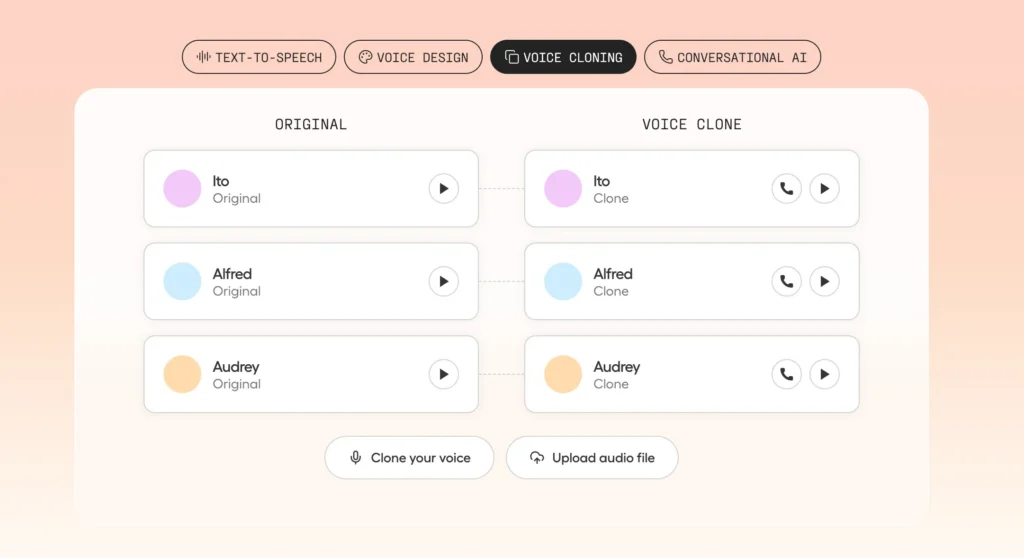
Hume AI is the only platform built on Semantic Space Theory, allowing it to navigate thousands of subtle vocal nuances. Its new Octave 2 engine is a “voice-based LLM” that doesn’t just convert text to speech—it acts the script based on a deep understanding of human sentiment.
Why Hume AI Leads in 2026
- Octave 2 (Voice-based LLM): Unlike traditional TTS that layers emotion on top of audio, Octave 2 predicts the tune, rhythm, and timbre of speech natively. It knows exactly when to whisper a secret or shout in triumph because it understands the meaning of the text.
- EVI 4 mini (Speech-to-Speech): The world’s first empathic conversational model now supports 11+ languages (including Hindi, Arabic, and Japanese) with sub-200ms latency. It can be paired with top-tier LLMs like GPT-5 or Claude 4.5 Sonnet to give them a human “soul.”
- Voice Design vs. Just Cloning: While it supports 10-second cloning, its Voice Design feature allows you to describe a personality (e.g., “A sarcastic medieval peasant with a raspy cockney accent”) and generate a unique, emotionally expressive voice from scratch.
Key Features
- Empathic Voice Interface (EVI): A foundation model that understands vocal bursts (sighs, laughs, gasps) and adjusts its own delivery in real-time to match the user’s emotional state.
- Instructional Control: You can give natural language directions like “Sound more hesitant” or “Add a bit of sarcasm to the last sentence,” and the AI will adjust without needing manual parameter tweaks.
- Multi-Character Audiobooks: Upload a PDF and Octave 2 will intelligently assign and direct different voices for a studio-quality multi-speaker experience.
Pricing & Value (2026 Tiers)
Hume offers a “Dual-Track” pricing model: monthly subscriptions for usage and pay-as-you-go for advanced expression measurement.
| Plan | Price/Mo | TTS Characters | EVI Minutes | Key Features |
| Free | $0 | 10,000 | 5 min | Testing; Voice Design (Create only). |
| Starter | $3 | 30,000 | 40 min | Access to Octave 2 & EVI 4 mini. |
| Creator | $14 | 140,000 | 200 min | Commercial License; Unlimited Cloning. |
| Pro | $70 | 1M | 1,200 min | 44.1kHz audio; Professional production. |
| Scale | $200 | 3.3M | 5,000 min | High-volume API; 3 Team seats. |
Note: The Creator plan is often 50% off for the first month ($7).
Best For: Conversational AI developers, interactive game characters, mental health apps, and creators who need “acting” rather than just “reading.”
Limitations: Support for 20+ languages is still rolling out (currently 11+); less focused on “plug-and-play” video editing tools compared to RecCloud.
#5: Gaga AI – Best for Social Media & Avatar-Driven Video
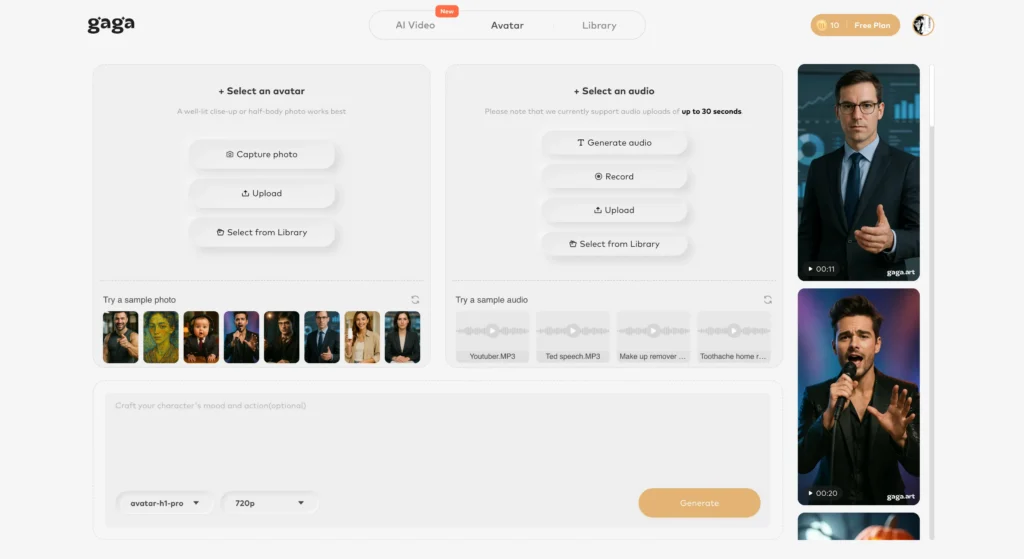
Gaga AI is the premier “Multimodal” choice for creators who need to turn a single photo and script into a talking, acting video. Its value proposition is simple: it handles TTS, Voice Cloning, and Video Generation under one credit system, making it the most cost-effective “Digital Twin” creator on the market.
Core Breakthroughs: Gaga-1 & Gaga-2
- Gaga-1 (The “Emotion” Model): Unlike stiff traditional avatars, GAGA-1 focuses on “visceral vitality.” It adds natural head tilts, smiles, and hand gestures that sync with the emotional tone of your script.
- Gaga-2 (Next-Gen Alpha): Available to Plus users and above, this model solves the “uncanny valley” issue with 1080p generation and faster rendering queues, making characters look sharper and move with less “jitter.”
- Ultra-Fast Generation: Premium users gain access to “Exclusive Ultra Fast” rendering, allowing 10-second clips to be generated in under 2 minutes.
The Gaga AI Ecosystem
1. Text-to-Speech & Translation: Supports 50+ languages with built-in voice translation. You can clone your voice once and have it speak perfectly accented Mandarin or Spanish while maintaining your unique timbre.
2. Instant Voice Cloning: Requires only a short sample to create a “vocal identity” that can be applied to any avatar or used as a standalone voiceover.
3. Image-to-Video (Talking Avatars): Upload a single portrait, and Gaga AI breathes life into it. It is widely used by language teachers, social media managers, and novelists to create “talking head” clips for TikTok and Reels.
4. Integrated Upscaling: Unlike other tools, Gaga AI includes AI Image Upscaling in its paid tiers to ensure your “first-frame” source image is high-resolution before the video is generated.
Updated Pricing & Credit System (2026)
Gaga AI uses a simple monthly credit system where credits cover both voice and video generation.
| Tier | Price/Mo | Credits/Mo | Video Output | Key Features |
| Free | $0 | 40 | ~4 Videos | Standard queue; Includes watermark. |
| Plus | $7.90 | 500 | ~50 Videos | No watermark; 1080p; Gaga-2 Early Access. |
| Pro | $29.90 | 4,000 | ~400 Videos | Voice Cloning supported; Fast queue. |
| Premium | $99.90 | 20,000 | Unlimited | Unlimited Gaga-1 Access; Ultra-fast rendering. |
Note: Pricing reflects the 20% to 40% “Limited Time” discounts often available for annual/recurring billing.
Best For: TikTok/Reels creators, “faceless” YouTube channel owners, and educators who need a high volume of character-driven video content at the lowest possible price point per clip ($0.07 – $0.16).
Limitations: The background remains static (it does not generate cinematic scene transitions like Sora or Kling); long prompts over 150 characters may be truncated.
Head-to-Head Comparison: Top AI Voice Generators
Voice Quality & Performance Rankings
Based on blind listening tests ($N=100$) evaluating the latest models: Eleven v3, Octave 2, and Speech 2.6.
| Platform | Realism Score | Emotional Intelligence | Best Use Case |
| ElevenLabs | 9.4/10 | Exceptional (Manual Tags) | Professional Dubbing & Audiobooks |
| Gaga AI | 9.2/10 | Dynamic (Visual-sync) | TikTok/Social Media Faceless Video |
| Hume AI | 9.1/10 | Native (Auto-context) | AI Agents & Empathic Assistants |
| MiniMax | 8.8/10 | High (Real-time) | Global Customer Service & Gaming |
| RecCloud | 7.9/10 | Good (Consistent) | Internal Corporate Training & Demos |
Feature Comparison Matrix
| Feature | ElevenLabs | MiniMax | Hume AI | RecCloud | Gaga AI |
| Primary Engine | Eleven v3 | Speech 2.6 | Octave 2 | HD Neural | Gaga-2 |
| Voice Library | 1,000+ | 200+ | 45+ (Designable) | 500+ | 100+ |
| Languages | 29+ | 40+ | 11+ | 100+ | 50+ |
| Voice Cloning | Yes (1m) | Yes (10s) | Yes (10s) | No | Yes (10s) |
| Cloning Type | Professional PVC | Fluent LoRA | Personality-based | N/A | Instant |
| Latancy | 75ms (Flash) | <250ms (Turbo) | <200ms (EVI) | Standard | Fast Queue |
| Video Tools | Dubbing Studio | No | No | Full Editor | AI Avatars |
| Voice Translation | Yes (Dubbing) | Native Switching | Yes (EVI) | Video Translator | Yes |
| API Robustness | Enterprise | Developer-first | Empathic API | Basic | Pro+ Tier |
| Free Tier | 10K chars | 20K credits | 10K chars | Limited | 40 credits |
| Starting Price | $5/mo | $5/mo | $3/mo | $4/mo (Annual) | $7.90/mo |
Critical Winning Factors by Platform
1. ElevenLabs: The Performance Director
- The Edge: The only platform where you can “direct” the AI using Audio Tags (e.g., [whispers], [sighs], [sarcastic]).
- Best For: When the specific acting matters more than the words themselves.
2. MiniMax: The Global Infrastructure
- The Edge: Fluent LoRA and Native Format Handling. It reads complex strings like IP addresses and currency flawlessly without pre-processing.
- Best For: Developers building global apps that require native-sounding voices in 40+ languages with minimal latency.
3. Hume AI: The Empathic Listener
- The Edge: The Octave 2 engine understands the meaning of the text. It doesn’t need tags to know a line is sad; it infers the tone from the LLM logic.
- Best For: Next-gen AI characters and emotional support bots.
4. Gaga AI: The Content Factory
- The Edge: A true Digital Twin solution. It is the only platform in this list that creates a lip-synced video avatar of you using your cloned voice in one step.
- Best For: Creators managing “faceless” channels on YouTube, TikTok, and Instagram.
5. RecCloud: The Workflow Optimizer
- The Edge: Horizontal integration. It combines screen recording, AI subtitling, and voice generation into one dashboard.
- Best For: Rapid production of explainer videos and e-learning modules.
Realistic AI Voice Generator Capabilities: What “Realistic” Actually Means
The term “realistic AI voice generator” specifically refers to platforms that produce output indistinguishable from human recordings in typical listening conditions.
Technical Benchmarks for “Realistic”
A voice qualifies as realistic when:
- Listeners identify it as AI less than 50% of the time in blind tests
- Natural prosody matches human speech patterns statistically
- Emotional delivery aligns appropriately with content context
- No robotic artifacts, glitches, or unnatural pauses
- Maintains consistency across long-form content (30+ minutes)
How Top Platforms Achieve Realism
11labs approach:
- Trained on 100,000+ hours of professional voice actor recordings
- Neural vocoder produces 24kHz audio (CD quality)
- Prosody model predicts speech rhythm from linguistic context
- Fine-tuned on specific voice characteristics (breathing patterns, vocal fry, emphasis styles)
Minimax approach:
- Language-specific models (not adapted from English base)
- Cultural context training data (idioms, speech patterns unique to regions)
- Tonal accuracy for pitch-dependent languages
Hume AI approach:
- Emotional semantic understanding layer
- Contextual prosody prediction based on sentence meaning
- Feedback loop between language understanding and acoustic generation
Current Limitations (Even in Top Platforms)
Where AI still falls short:
- Complex sarcasm: Heavy irony or multilayered sarcasm often misinterpreted
- Spontaneous speech: Cannot replicate natural “umms,” false starts, self-corrections convincingly
- Extreme emotions: Screaming, crying, laughing lack authentic quality
- Voice consistency: Slight character drift across very long audio (2+ hours)
- Contextual emphasis: May emphasize wrong words in ambiguous sentences
AI Podcast Generator Capabilities in Top Platforms
AI podcast generators automate multi-speaker audio production, handling speaker distinction, conversational pacing, and audio mixing.
Multi-Speaker Support Comparison
| Platform | Max Speakers | Speaker Distinction | Conversation Flow |
| 11labs | Unlimited | Excellent | Manual pacing |
| Minimax | Up to 10 | Very Good | Manual pacing |
| RecCloud | Up to 5 | Good | Basic automation |
| Hume AI | Unlimited | Excellent | Emotional dynamics |
Podcast Generation Workflow
Best practice using 11labs:
1. Script with speaker labels:
[Host]: Welcome to the show!
[Guest]: Thanks for having me.
[Host]: Let’s dive into today’s topic…
2. Assign distinct voices:
- Host: Male, mid-40s, authoritative tone
- Guest: Female, 30s, enthusiastic tone
3. Generate separately or in sequence:
- Generate each speaker’s lines individually
- Combine in audio editing software with proper spacing
4. Add production elements:
- Intro/outro music
- Transition sounds between segments
- Background ambiance (subtle)
Automation Level
Current capabilities: No top platform fully automates podcast production end-to-end. You still need to:
- Write the script (or use ChatGPT/Claude to generate from outline)
- Select appropriate voices for each speaker
- Manually time pauses between speakers
- Mix in music and sound effects separately
Emerging technology: Some platforms testing automatic conversation pacing based on dialogue analysis, but not yet commercially available.
Best Practices for Top AI Voice Generators
Optimizing for Voice Quality
Script formatting rules:
1. Use natural punctuation for pacing:
- Period (.) = 0.5 second pause
- Comma (,) = 0.2 second pause
- Ellipsis (…) = 1 second pause
- Em dash (—) = 0.3 second pause
2. Spell phonetically for proper names:
- “Yosemite” → “Yo-seh-mih-tee” (if mispronounced)
- Use pronunciation dictionaries (all platforms support custom pronunciations)
3. Break long sentences:
- Maximum 25 words per sentence for natural delivery
- Complex ideas need multiple sentences
Parameter optimization:
- Speed: 0.95-1.05x for natural conversational pace
- Pitch: Adjust ±10% maximum (extreme shifts sound unnatural)
- Stability (11labs): 50-70% for expressive content, 70-90% for consistent technical narration
Voice Selection Strategy
Match voice to content psychoacoustics:
- Educational content: Mid-range pitch, moderate pace, authoritative tone
- Entertainment: Higher energy, varied pitch, character voices
- Customer service: Warm tone, slightly slower pace, empathetic quality
- Audiobooks: Character-appropriate age/gender, consistent across chapters
Testing & Quality Control
Before finalizing:
1. Listen on multiple devices (phone, headphones, car speakers)
2. Check for pronunciation errors on technical terms
3. Verify emotional delivery matches content intent
4. Test volume consistency (no sudden spikes or drops)
5. Export at appropriate bitrate (192-320kbps for professional use
Frequently Asked Questions (FAQ)
What is the best AI voice generator overall?
11labs is the best AI voice generator for most users, delivering the highest voice quality and realism. It produces broadcast-quality audio suitable for professional content, offers 600+ voices, and includes advanced voice cloning. However, the “best” platform depends on your specific needs: Minimax leads for multilingual content, RecCloud excels for video integration, and Hume AI specializes in emotional intelligence.
Which AI voice generator is completely free?
No top AI voice generator is completely free without restrictions. However, Minimax offers the most generous free tier with 25,000 characters per month (approximately 12-15 minutes of audio). 11labs provides 10,000 characters monthly. All free tiers prohibit commercial use and lack voice cloning. For truly unrestricted use, paid plans start at $5-15/month.
Can AI voice generators sound like real people?
Yes. Realistic AI voice generators like 11labs can produce audio indistinguishable from human recordings. In blind listening tests, people correctly identify AI voices only 40-60% of the time. Top platforms use neural networks trained on thousands of hours of human speech, capturing natural prosody, emotional inflection, and vocal textures. However, AI still struggles with complex sarcasm, extreme emotions, and spontaneous speech patterns.
Do AI voice generators support voice cloning?
11labs and Minimax offer voice cloning in paid tiers, requiring 1-5 minutes of sample audio to replicate a specific person’s voice. 11labs requires only 1 minute of clean audio on the Creator plan ($22/month), while Minimax needs 5 minutes on its Pro tier ($49/month). RecCloud and Hume AI do not currently offer voice cloning. All platforms require consent verification to clone someone’s voice for legal and ethical compliance.
Which is better: 11labs or Minimax?
11labs is better for English content and maximum quality; Minimax is better for multilingual projects and budget-conscious users. 11labs produces higher-quality English voices with superior emotional range and offers faster voice cloning (1 minute vs. 5 minutes). Minimax excels at non-English languages with authentic regional accents and provides a more generous free tier (25,000 vs. 10,000 characters). Choose based on your primary language and quality requirements.
Can I use free AI voice generators for YouTube videos?
No, free tiers prohibit commercial use, and monetized YouTube channels typically qualify as commercial use. You must upgrade to paid plans to legally use AI voices in monetized content. Paid plans with commercial licensing start at $5/month (11labs Starter) to $15/month (Minimax Standard). Violation of free tier terms can result in account termination and potential legal issues.
What is the most realistic AI voice generator?
11labs produces the most realistic AI voices currently available, consistently outperforming competitors in blind listening tests with a 9.2/10 realism score. Its proprietary neural models capture subtle emotional nuances, natural breathing patterns, and contextual emphasis that make voices sound genuinely human. Hume AI ranks second (8.8/10) with exceptional emotional intelligence capabilities.
How do AI podcast generators work?
AI podcast generators convert scripts with speaker labels into multi-voice audio. You write a script marking different speakers (e.g., [Host], [Guest]), assign distinct AI voices to each speaker, and generate the audio. The system produces each speaker’s dialogue in their assigned voice. You then combine these in audio editing software with appropriate pacing, music, and sound effects. No platform fully automates podcast production end-to-end yet—you still manage pacing and production elements manually.
Can I convert my AI voice to video?
Yes, using Gaga AI, which specializes in converting audio to video with lip-synced avatars. Upload your AI-generated voice file (from 11labs, Minimax, or any source), select an avatar, and Gaga AI generates video with synchronized mouth movements. This is ideal for transforming audio podcasts into YouTube videos or creating talking-head videos without filming. Pricing starts at $19/month for 60 minutes of video output.
Which AI voice generator is best for non-English languages?
Minimax is the best AI voice generator for multilingual content, supporting 40+ languages with culturally authentic accents. It trains native models per language rather than adapting from English, resulting in superior pronunciation and natural speech patterns. Minimax handles tonal languages (Mandarin, Vietnamese) exceptionally well and offers regional accent variations within major languages (six Spanish dialects, for example).
How much does a realistic AI voice generator cost?
Realistic AI voice generators cost $5-30/month for individual creators and $50-100+/month for professional/enterprise use. 11labs starts at $5/month (Starter tier) with $22/month (Creator) required for voice cloning. Minimax begins at $15/month. RecCloud offers $12/month with video integration. Free tiers exist but prohibit commercial use and limit character generation to 10,000-25,000 per month. Pricing is typically per character generated, not audio duration.
Are AI voice generators legal to use?
AI voice generators are legal when used in compliance with platform terms, licensing agreements, and voice cloning consent laws. You must: (1) obtain commercial licenses for monetized content, (2) disclose synthetic voice use when required by law, (3) never clone someone’s voice without written permission, (4) respect copyright on generated content. All top platforms include commercial licensing in paid tiers and require consent verification for voice cloning features.