Key Takeaways
- V2M-Zero is a zero-pair generative AI framework that creates time-synchronized music for video content without relying on paired video-music training datasets.
- The model solves the cross-modality gap by extracting temporal event curves, which measure when and how much change occurs rather than what is changing.
- By training exclusively on clean music-text pairs and swapping in video event curves at inference time, V2M-Zero eliminates audio artifacts caused by noisy internet data.
- In benchmark testing across OES-Pub, MovieGenBench-Music, and AIST++, V2M-Zero delivers a 21% to 52% improvement in temporal synchronization and up to 21% higher audio quality than state-of-the-art paired methods.
- Actionable integration: You can pair V2M-Zero’s audio generation with platforms like the Gaga AI video generator to achieve a full-stack production pipeline spanning image to video ai, ai avatar rendering, and ai voice clone technologies.
Table of Contents
What is V2M-Zero?
V2M-Zero defines a novel, zero-pair video-to-music generation approach that synthesizes temporally aligned audio tracks for dynamic video sequences by leveraging intra-modal structural similarities.
Historically, the standard method for teaching an AI to score a video involved training it on millions of paired video-and-music datasets gathered from the internet. This approach suffers from massive flaws. Internet data often includes unwanted vocals, poor audio mixing, overlapping sound effects, and strict copyright protections. Consequently, models trained on this data generate muddy audio and struggle to decipher whether a specific sound corresponds to a visual cut or an abstract textual prompt.
V2M-Zero fundamentally bypasses this problem through a “zero-pair” architecture. The framework is trained entirely on high-quality, licensed music tracks paired with text—completely blind to video. Because a video scene transition (a visual event) and a musical drop (an audio event) both generate measurable “spikes” in structural change, V2M-Zero can use these spikes as a universal timing language. By the time the user uploads a video during the inference stage, the model simply reads the video’s rhythm and perfectly syncs the music.
The Context: Evolution of AI Music Generation and the Modality Gap
The core problem V2M-Zero solves is the “modality gap,” an issue where traditional Text-to-Music models successfully capture high-level semantic mood but completely fail to align beats with visual actions.
To understand why V2M-Zero is a massive leap forward for AI-first SEO and media generation, we must look at the user journey and evolution of generative audio tools.
From Text-to-Music (T2M) to Video-to-Music (V2M)
Over the past two years, Text-to-Music (T2M) models (like MusicGen or Stable Audio) have mastered semantic control. If a user prompts “upbeat synthwave for a running scene,” these models will output high-fidelity audio that broadly matches the mood. However, content creators, film editors, and marketing agencies face a strict limitation: the generated music rarely hits the key visual transitions. If the runner in the video suddenly stops at second 0:14, the T2M model has no way of knowing this, and the upbeat synthwave simply continues, requiring tedious manual editing.
Early Video-to-Music models attempted to fix this by analyzing the video frames directly alongside the audio. However, visual semantics (pixels, people, objects) and audio semantics (frequencies, pitches, instruments) exist in entirely different high-dimensional spaces.
Decoupling Timing from Content
V2M-Zero introduces a paradigm shift: it separates what is happening from when it is happening.
- The “What”: Handled by an advanced Text-to-Music foundation model. A multimodal LLM looks at the video, summarizes its mood into a text prompt, and passes it to the music generator.
- The “When”: Handled by Temporal Event Curves. This is the true innovation of V2M-Zero. It extracts the raw mathematical rhythm of the video, stripped of all imagery, and forces the audio model to place its musical transitions precisely where those visual rhythms peak.
How V2M-Zero Works: Technical Architecture and Event Curves
V2M-Zero operates on a three-phase pipeline: intra-modal temporal event curve computation, lightweight rectified flow model fine-tuning, and zero-pair test-time swapping.
For engineers, data scientists, and technical content developers looking to deploy this framework, understanding the mathematical and architectural mechanisms is critical.
1. Computing Temporal Event Curves
The foundational concept of V2M-Zero requires understanding that both music and video are sequential data. V2M-Zero represents structural transitions over time as standardized numerical curves.
- Feature Extraction: During training, a pretrained audio encoder (MusicFM) converts raw audio into high-dimensional feature vectors. During inference, a vision encoder (like DINOv2) converts video frames into visual feature vectors.
- Measuring Dissimilarity: The system calculates the cosine dissimilarity between consecutive segments. If frame 1 and frame 2 are identical, the dissimilarity is 0. If frame 1 is a dark room and frame 2 cuts to a bright outdoor scene, the dissimilarity spikes.
- Standardization and Smoothing: The raw dissimilarity signal is often excessively noisy. V2M-Zero applies a 1D Hann window to smooth the data, followed by Z-score standardization (zero mean, unit variance). This results in a clean “Event Curve” that looks identical whether it was generated by a video cut or a drum beat.
2. Rectified Flow Model Fine-Tuning
At the heart of V2M-Zero is a Diffusion Transformer (DiT) base model with roughly 1 billion parameters. The model operates on continuous audio latents compressed by a neural audio codec at a rate of 12.3 Hz. The team initialized a pretrained text-to-music DiT and added a tiny projection layer (merely 2,048 new parameters). During a lightweight fine-tuning phase (taking only 192–768 GPU hours), the model practices generating music while heavily conditioned on the music event curves. This teaches the latent flow model how to explicitly follow predefined temporal structures.
3. Zero-Pair Inference via Event Curve Swapping
When an end-user generates music for a video, the following takes place:
- Visual Encoding: The system takes the video and generates a visual event curve using DINOv2. Data regarding the actual visuals is discarded; only the structural timing curve remains.
- Prompt Generation: A multimodal tool (like the Vibe system) reads the video and generates a text prompt (e.g., “Dramatic orchestral strings building tension”).
- Curve Swapping: Because the visual event curve is mathematically identical in structure to an audio event curve, the system swaps it in as the condition for the frozen flow model. The output is a flawless, time-locked musical composition.
V2M-Zero Performance vs Paired Methods
Empirical benchmarks prove that V2M-Zero achieves state-of-the-art results over fully supervised alternatives, yielding massive gains in audio fidelity, semantic alignment, and temporal synchronization.
When analyzing AI generative tools, performance metrics establish the hierarchy. The V2M-Zero developers tested the model extensively against major benchmarks, including OES-Pub, MovieGenBench-Music, and the AIST++ dance dataset. The comparative analysis reveals significant advantages:
Metric 1: Audio Quality (FAD)
The Fréchet Audio Distance (FAD) measures how realistic and clean generated audio sounds relative to human-composed reference audio. Lower is better. V2M-Zero achieved a 5% to 21% reduction in FAD scores compared to paired-data models. By avoiding messy, copyright-dodging internet datasets, the text-to-music backbone generates studio-quality sound without artifacting.
Metric 2: Semantic Alignment (CLAP)
Contrastive Language-Audio Pretraining (CLAP) score evaluates whether the returned audio actually sounds like the requested text prompt. V2M-Zero posted a 13% to 15% improvement here. Because the model relies on a clean MLLM pipeline to dictate semantics independently from the visual tracking, it captures emotional undertones far better than entangled cross-modal models.
Metric 3: Temporal Synchronization (SCH & BeatLine)
Semantic-Conditioned Hitting (SCH) and Beat Alignment evaluate exactly how well the musical beat drops align with on-screen action. This is the framework’s core specialty. V2M-Zero scored between 21% and 52% higher on SCH across benchmarks.
Furthermore, during specific ablation testing on AIST++ dance videos, swapping the general vision encoder for a dense motion tracker (CoTracker) yielded a massive 28% boost in beat-to-movement alignment.
Actionable Steps: Implementing V2M-Zero in Production
To implement V2M-Zero into a media pipeline, you must establish an environment for visual feature extraction, process the video into a standardized event curve, generate the LLM prompt, and run the inference flow.
Deploying this capability is highly actionable. Below is the step-by-step workflow required to execute zero-pair generation successfully:
Step 1: Prepare Your Media and Environment
Ensure your target video is scrubbed of pre-existing audio and standardized to a consistent frame rate (typically 24 fps). Initialize your text-to-music Diffusion Transformer and load the pre-trained weights for the condition projection layer.
Step 2: Choose and Deploy the Vision Encoder
The flexibility of V2M-Zero allows you to choose the vision model based on your content type:
- For Cinematic or General Content: Use DINOv2, a foundation model excellent at spotting broad scene transitions, lighting differences, and major staging changes.
- For Fast Action or Dance: Use CoTracker, a model that tracks dense point movements across frames. It registers rapid kinetic changes rather than broad frame shifts. Run your video through the chosen encoder and calculate the cosine dissimilarity matrix across the frames to create your raw curve.
Step 3: Curve Standardization
If you skip this step, the modality gap will ruin the output. You must apply a smoothing filter (like a Hann Window) to flatten micro-noise. Then, normalize the array to zero mean and unit variance. Interpolate or resample this curve to match your continuous audio latent frequency (e.g., 12.3 Hz).
Step 4: Automate the Semantic Prompt
Pass your video file into a Multimodal Language Model. Instruct the MLLM to output a dedicated music prompt, dictating genre, tempo context, instrumentation, and emotion. Example: “A fast-paced, electronic cyberpunk bassline that builds tension before releasing into a heavy drop.”
Step 5: Execute Inference
Feed both the MLLM text prompt and your standardized visual event curve into the fine-tuned V2M-Zero model. The transformer will generate latent audio tokens that the neural codec decodes back into a pristine 44.1 kHz stereo waveform, synchronized precisely to your video.
Troubleshooting: How to Fix Alignment and Modality Gap Issues
Troubleshooting V2M-Zero typically requires adjusting the event curve smoothing parameters or swapping the vision encoder to better match the specific dynamic nature of the input video.
When operating in a zero-pair ecosystem, anomalies occasionally arise. Here is how to diagnose and correct them:
Misaligned Beats on Kinetic Videos
Symptom: You upload a complex dance video, but the music hits on the camera pans rather than the dancer’s foot-strikes. Solution: The issue lies with your encoder. Foundation models like DINOv2 prioritize global frame changes (like camera movement or lighting). Switch your encoder to CoTracker or a localized optical flow tracker. This forces the model to ignore camera pans and focus entirely on the physical kinetic shifts of the subject.
Semantic Mismatch
Symptom: The transitions hit perfectly, but a sad, dramatic scene generates upbeat pop music. Solution: V2M-Zero relies solely on the text prompt for the “What.” Your MLLM captioner is likely misinterpreting the visual mood. Implement a more aggressive system prompt for the VLM step to emphasize emotional context over objective description.
“Jittery” or Chaotic Music Generation
Symptom: The generated music fluctuates too frequently, changing tempo or instruments every half second. Solution: This is a classic modality gap issue. Video frames change faster and more chaotically than musical beats. You must increase the size of your Hann window during the smoothing phase of the event curve calculation. A highly smoothed curve forces the audio model to only react to major, deliberate scene transitions.
Bonus: Expanding Workflows with the Gaga AI Video Generator
Integrating V2M-Zero with a comprehensive suite like the Gaga AI Video Generator empowers content creators to automate the entire production cycle, leveraging image to video AI, video and audio infusion, AI avatars, and TTS text-to-speech.
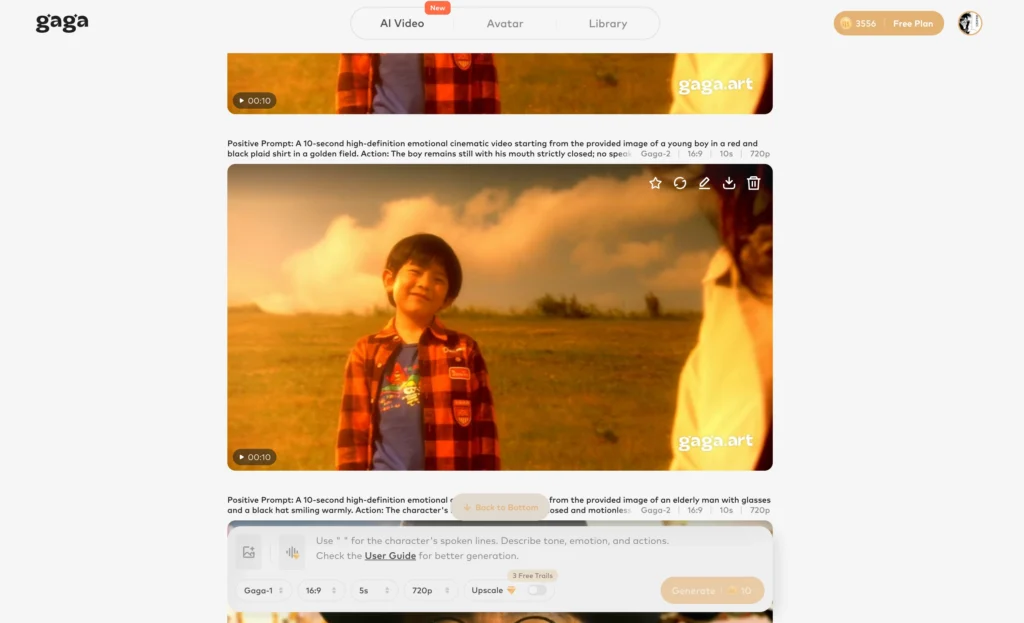
V2M-Zero solves the critical problem of background music synchronization, but professional content creation requires complementary visual and vocal workflows. By bridging the V2M-Zero pipeline with the Gaga AI video generator, users unlock full generative studio capabilities.
1. Image to Video AI
Before you can score a video, you need high-quality footage. Gaga AI’s image to video ai converts static concepts, product photography, or Midjourney-generated art into dynamic, cinematic shots. Creators can define specific camera trajectories, pans, and fluid dynamics. Once the visual sequence is established, V2M-Zero can step in to generate the perfectly aligned background score based on the newly created camera cuts.
2. Video and Audio Infusion
Having the perfect track is only half the battle; mixing is equally vital. Gaga AI’s advanced video and audio infusion capabilities ensure that V2M-Zero’s output blends seamlessly into the final project. If the video features dialogue or voiceovers, the infusion software automatically detects speech frequencies and “ducks” the music volume, serving as an automated sound engineer and bypassing the need for manual audio equalization.
3. AI Avatar Visual Representation
Not all videos are simply B-Roll montages; corporate, educational, and marketing domains rely heavily on human presence. Gaga AI provides an incredibly realistic ai avatar ecosystem. Creators can generate custom, photorealistic digital humans that feature micro-expressions and precise lip-syncing. V2M-Zero can track the avatar’s broad hand gestures or slide transitions to trigger subtle musical cues, resulting in highly engaging presentation videos.
4. AI Voice Clone and TTS
To complete a rich auditory landscape, the music must be complemented by high-quality narration. Gaga AI features robust ai voice clone technology and advanced tts (Text-to-Speech). By uploading just a brief 30-second audio footprint, the AI perfectly clones the user’s cadence and vocal timbre. This allows you to generate dynamic voiceovers in multiple languages while V2M-Zero simultaneously provides the perfect underlying beat.
The combination of V2M-Zero for generative timing and Gaga AI for holistic audiovisual creation represents the apex of modern automated content workflows.
Frequently Asked Questions (FAQ)
What is the main advantage of the V2M-Zero model over earlier video-to-music models?
V2M-Zero operates on a “zero-pair” framework. Earlier models relied on cross-modal training using internet-scraped datasets containing paired videos and music, which suffer from copyright issues, sound effect noise, and poor audio quality. V2M-Zero bypasses this completely by training exclusively on perfectly clean music tracks, achieving significantly higher audio fidelity and precise temporal alignment.
How does V2M-Zero know when to drop the beat if it isn’t trained on video?
It relies on “Event Curves.” During training, the model analyzes the structural rhythm of a music track and maps it to a mathematical curve. When you upload a video, the system extracts a similar structural curve based on changes in the visual frames (like a camera cut). The model swaps the video curve in place of the music curve to match the timing perfectly without ever having learned what “video” actually is.
Can I control the genre of music generated by V2M-Zero?
Yes. While the event curve controls when the musical transitions happen, the model still requires a text prompt to know what genre or emotion to generate. In the V2M-Zero pipeline, a Multimodal LLM automatically analyzes your video footage and generates a descriptive prompt (like “Fast jazz piano”) to guide the style of the output.
What visual encoders work best with V2M-Zero?
Flexible encoder selection is a primary feature of the framework. For cinematic videos and commercial ads with frequent camera cuts, general foundation models like DINOv2 perform best. For highly specific rhythmic videos, such as a localized dance performance, dense point trackers like CoTracker are vastly superior as they accurately identify human limb movements.
Is it difficult to fine-tune the V2M-Zero model?
No, it is highly efficient. The architecture involves taking a massive pretrained text-to-music Diffusion Transformer and adding a trivial 2,048 parameters. The fine-tuning phase to teach the model how to follow an event curve requires only 192 to 768 GPU hours, making it highly accessible compared to training fundamental multimedia models from scratch.