
Key Takeaways
- AI debate tools use advanced language models to generate structured arguments, counterarguments, and rebuttals on virtually any topic within seconds
- Primary use cases include competitive debate preparation, classroom teaching, speech writing, and critical thinking practice
- Leading platforms like Deep AI, Junia AI, and Character AI offer free, browser-based debate generation without requiring downloads or accounts
- Best for students, educators, debate coaches, content creators, and professionals seeking to explore multiple perspectives quickly
- Critical limitation: AI-generated arguments require fact-checking and human refinement before use in formal settings
Table of Contents

During the recent NYC mayoral debate, candidates demonstrated the power of rapid-fire argumentation and real-time rebuttals—skills that traditionally took years to master. Now, AI is changing the game entirely.
AI debate tools let anyone generate sophisticated arguments, explore counterpoints, and practice rhetorical strategies instantly. Whether you’re a student preparing for a tournament, a teacher designing classroom activities, or a professional crafting a persuasive presentation, these tools compress hours of research into minutes.
The shift matters because argumentation skills extend far beyond debate stages. From boardroom pitches to essay writing, the ability to construct logical arguments and anticipate opposing viewpoints has become essential. AI debate generators are making these skills accessible to everyone, democratizing what was once available only to experienced debaters and professional speechwriters.
What Is AI Debate?
AI debate refers to artificial intelligence systems that generate, analyze, or engage in structured argumentation on specific topics. These tools use large language models trained on vast repositories of human reasoning to produce coherent arguments and counterarguments.
How AI Debate Tools Work
AI debate generators operate through three core steps:
1. Prompt Analysis The system interprets your debate topic, position, audience, and format requirements.
2. Argument Synthesis Language models construct claims, supporting reasons, evidence examples, and logical warrants.
3. Structured Output The AI organizes content into debate-ready formats including contentions, rebuttals, and cross-examination points.
Unlike simple content generators, debate AI specifically optimizes for logical coherence, argument structure, and persuasive effectiveness.
Why This Matters Now
Traditional research required hours of reading policy papers, academic journals, and news sources to build a single case. AI debate tools compress this timeline by:
- Extracting relevant reasoning patterns from training data
- Identifying common argumentative structures for specific topics
- Generating context-appropriate evidence examples
- Anticipating logical objections and preparing refutations
Top AI Debate Generators: Platform Comparison
Deep AI Debate Bot
Deep AI debate offers an interactive debate bot that holds live argumentative conversations on nearly any topic. Rather than generating static text, this tool engages you in back-and-forth exchanges, challenging your positions and forcing real-time critical thinking.
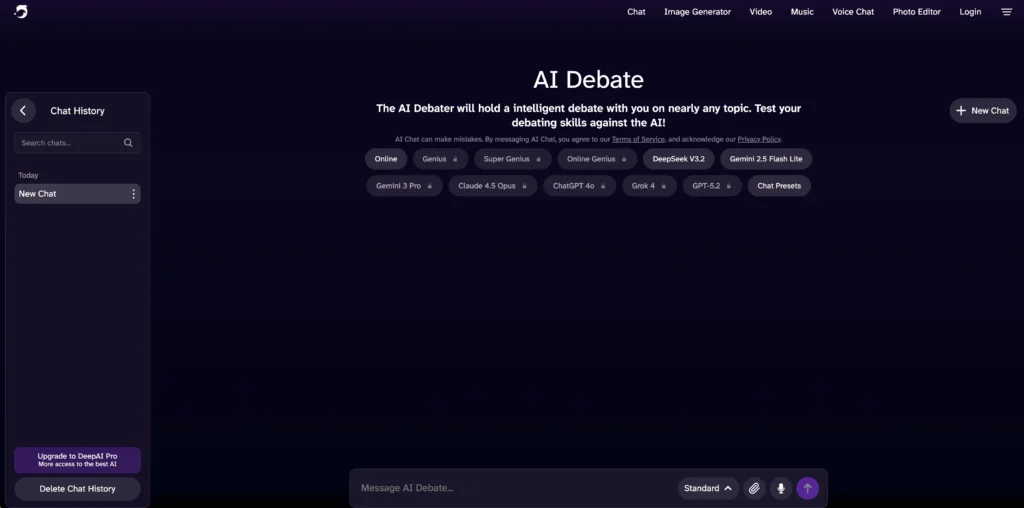
Key features:
- Real-time conversational debate interface
- Multiple AI model options (GPT-4o, Claude 4.5 Opus, Gemini Pro)
- No account required for basic use
- Adapts argumentation style based on your responses
Best for: Practicing impromptu speaking, testing argument strength through live interaction, and developing quick thinking under pressure.
Junia AI Debate Generator
Junia AI’s debate generator is a free, browser-based tool that produces structured debate cases complete with claims, warrants, evidence, and rebuttals. This platform excels at creating comprehensive argument frameworks you can customize and refine.
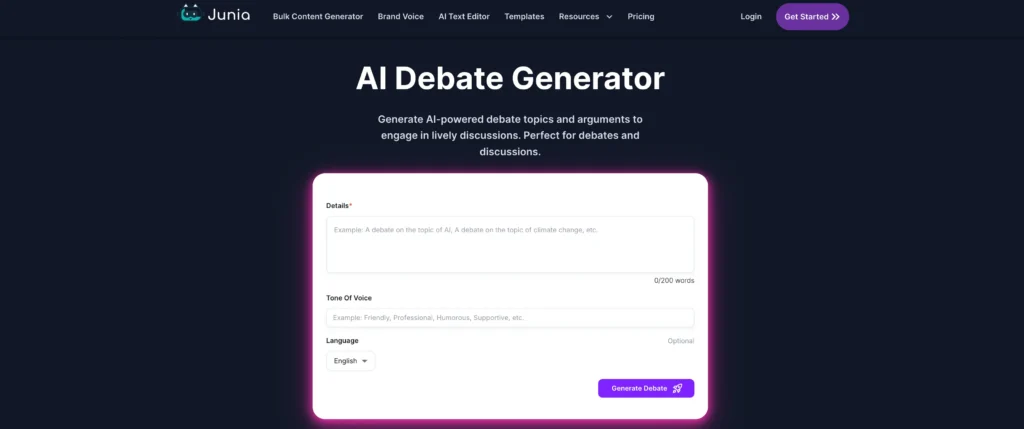
Key features:
- Generates full pro/con case structures
- Produces main claims, supporting reasons, and evidence-style details
- Creates potential rebuttals and counterarguments
- Requires no technical skills or debate experience
- Completely free with no download required
Best for: Competitive debate preparation, classroom teaching materials, and essay outlining.
Character AI
Character AI lets you create custom debate opponents with specific personalities, expertise levels, and argumentation styles. This platform excels at simulating debates against historical figures, subject matter experts, or fictional characters.
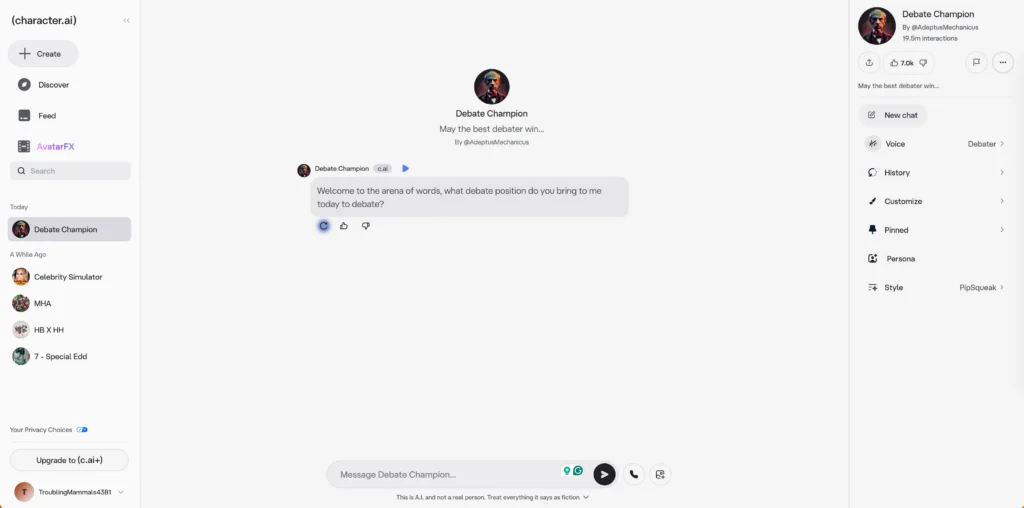
Key features:
- Customizable opponent personalities
- Persistent conversation memory across sessions
- Natural language interaction
- Community-created debate characters
Best for: Exploring diverse perspectives, practicing against specific argument styles, and engaging younger learners through creative scenarios.
AI Debate Video Generators
Gaga AI extends debate generation into multimedia formats, converting text arguments into video presentations featuring AI avatars.
gaga ai debate video generator
Capabilities include:
- Text-to-speech conversion for debate scripts
- AI avatar video creation
- Image-to-video transformation for visual evidence
Best for: Creating presentation materials, video essays, and multimedia debate demonstrations.
How to Use an AI Debate Generator: Step-by-Step
Step 1: Define Your Debate Motion Clearly
Formulate your topic as a specific, debatable proposition rather than a vague question.
✅ Good: “This house believes that social media companies should be legally liable for user-generated content”
❌ Poor: “Social media problems”
Include these details:
- The exact resolution or motion
- Your assigned position (affirmative/negative, pro/con)
- Debate format (Policy, LD, PF, Parliamentary)
- Target audience level (novice, varsity, professional)
Step 2: Generate Initial Arguments
Enter your prompt into the AI debate generator. A typical output includes:
- Contentions: 2-4 main claims supporting your position
- Warrants: Logical reasoning connecting claims to the resolution
- Evidence examples: Specific scenarios, statistics, or expert opinions
- Impact analysis: Why your arguments matter
Step 3: Request Counterarguments and Rebuttals
The most powerful application is generating opposition arguments to strengthen your own case.
Ask the tool to:
- Generate the strongest possible case for the opposing side
- Identify vulnerabilities in your arguments
- Create specific rebuttals to anticipated objections
- Develop turns (arguments that flip opposing logic to support your side)
Step 4: Refine and Fact-Check
AI-generated arguments require human verification and enhancement.
Critical refinement steps:
- Verify factual claims against authoritative sources
- Replace generic examples with specific, recent evidence
- Add unique insights the AI cannot access
- Adjust language to match your natural speaking style
- Strengthen logical connections between claims
Step 5: Practice and Iterate
Use the AI as a sparring partner by:
- Pasting your refined arguments back and asking for critiques
- Requesting different argument angles on the same topic
- Generating cross-examination questions
- Simulating judge questions and preparing responses
Competitive Debate Applications: Training and Tournament Prep
Building Tournament Cases
AI debate generators dramatically accelerate case construction for competitive debaters.
Effective tournament preparation workflow:
1. Initial case generation: Produce 3-4 contentions with full substructure
2. Evidence research: Use AI-identified argument angles to guide evidence searches
3. Rebuttal preparation: Generate anticipated negative arguments and prepare blocks
4. Case testing: Iterate through multiple AI critiques to identify weaknesses
Training New Debaters
Coaches use debate AI to:
- Show novices examples of complete, well-structured arguments
- Demonstrate proper claim-warrant-impact format
- Provide unlimited practice opponents without requiring human partners
- Generate drills focused on specific skills (rebuttals, cross-examination, framework)
Coaching note: Emphasize that AI-generated content represents a starting point, not a finished product. New debaters must learn to evaluate, verify, and improve AI outputs.
Practice Rebuttals and Clash
The most valuable competitive application is rebuttal generation.
Workflow:
1. Input your opponent’s case or likely arguments
2. Request targeted, specific responses to each contention
3. Generate turns and defensive responses
4. Practice flowing (note-taking) AI-generated speeches
5. Drill responses until fluent and natural
Limitations and Ethical Considerations
Factual Accuracy Concerns
AI debate generators create plausible-sounding arguments that may contain fabricated evidence or outdated information.
Common issues:
- Citation invention: The AI may reference non-existent studies or experts
- Statistical errors: Numbers may sound realistic but lack verification
- Temporal confusion: Arguments may reference outdated laws or policies
- Logical fallacies: Reasoning may sound sophisticated while containing flaws
Solution: Always verify factual claims against primary sources before using AI-generated arguments in formal settings.
Originality and Academic Integrity
Educational institutions have varying policies on AI-assisted debate preparation.
Key ethical considerations:
- Disclosure: Many tournaments and classrooms require disclosing AI assistance
- Original thinking: Using AI to generate ideas differs from using it to replace critical thinking
- Learning objectives: The goal is skill development, not winning through outsourcing
Best practice: Use AI as a research assistant and brainstorming partner, not a replacement for your own analytical work.
Bias and Perspective Limitations
AI models reflect patterns in their training data, which means:
- Arguments may favor Western perspectives on global issues
- Historical biases may appear in culturally sensitive topics
- Certain ideological frameworks may be underrepresented
- Marginalized viewpoints may receive less nuanced treatment
Mitigation strategy: Actively seek diverse sources and perspectives beyond AI-generated content, especially on topics involving social justice, cultural issues, or historical conflicts.
Deep AI Debate vs. Other Platforms: Choosing the Right Tool
When to Use Deep AI Debate
Choose Deep AI’s conversational debate bot when you need:
- Real-time practice against adaptive opposition
- Testing argument resilience through live interaction
- Developing impromptu speaking skills
- Experiencing authentic back-and-forth argumentation
Limitations: Less structured output compared to dedicated debate generators; better for practice than case construction.
When to Use Junia AI or Similar Generators
Choose structured generators like Junia AI when you need:
- Comprehensive case outlines with full substructure
- Written arguments to refine and customize
- Teaching materials for classroom use
- Starting frameworks for tournament preparation
Limitations: Static output requires iteration; no live interaction for testing arguments.
Hybrid Approach for Maximum Benefit
Most effective workflow combines multiple tools:
1. Case construction: Use Junia AI or similar for structured argument generation
2. Refinement: Manually fact-check, add evidence, strengthen logic
3. Testing: Feed refined arguments into Deep AI for live defense practice
4. Video creation: Use Gaga AI to create presentation versions for review
FAQ: Common Questions About AI Debate Tools
Can AI debate generators write my entire debate case?
AI tools can generate complete case structures with claims, reasoning, and evidence examples, but these outputs require substantial human refinement. Competitive-ready cases need verified evidence, original analysis, and strategic choices that AI cannot fully provide. Think of generators as advanced outlining tools rather than finished product creators.
Are AI-generated debate arguments allowed in tournaments?
Rules vary by organization and tournament. Many competitive circuits permit AI-assisted research and argument generation but require disclosure. Some prohibit reading AI-written cases verbatim. Always check specific tournament rules and err on the side of transparency with judges about your preparation methods.
How accurate is the evidence in AI debate generators?
AI-generated evidence examples are often generic, outdated, or fabricated. These tools create plausible-sounding claims rather than verified facts. You must independently verify every factual assertion, statistic, and citation before using AI-generated content in formal debate. Treat AI output as argument structure, not reliable evidence.
Can beginners use AI debate tools effectively?
Yes, with proper guidance. Beginners benefit from seeing well-structured argument examples that demonstrate claim-warrant-impact format. However, new debaters must learn to critically evaluate AI output rather than accepting it uncritically. The best educational approach treats AI as a teaching tool that shows patterns while developing independent analytical skills.
What’s the difference between a debate AI and a general chatbot?
Debate-specific AI tools optimize for argumentative structure, logical coherence, and persuasive technique. They understand debate formats, generate structured contentions with proper substructure, and create targeted rebuttals. General chatbots like ChatGPT can discuss topics but lack specialized debate formatting and may require extensive prompt engineering to produce tournament-appropriate output.
Can AI debate generators help with non-competitive argumentation?
Absolutely. These tools excel at exploring multiple perspectives on complex issues, developing persuasive business proposals, outlining argumentative essays, and practicing critical thinking. Any scenario requiring structured reasoning and counterargument analysis benefits from debate AI, whether in academics, professional settings, or personal decision-making.
How do I prevent AI-generated arguments from sounding robotic?
Post-generation refinement is essential. Replace generic phrasing with your natural voice, add personal examples and insights, vary sentence structure, incorporate rhetorical questions, and practice delivering arguments aloud to identify awkward phrasing. The AI provides structure; you provide authenticity.
What topics work best with AI debate generators?
AI performs well on topics with established argumentative frameworks and substantial training data: policy debates, ethical dilemmas, technology controversies, and current events. Performance decreases on highly specialized technical subjects, recent developments post-knowledge cutoff, and topics requiring insider expertise. Always supplement AI output with current research for time-sensitive topics.
Final Words
AI debate tools are democratizing argumentation skills that once required years of training. Just as the NYC mayoral debate showcased the enduring power of persuasive communication, platforms like Deep AI and Junia AI are making these capabilities accessible to everyone—students, professionals, educators, and curious minds alike.
The most successful users don’t treat AI as a shortcut to avoid thinking. Instead, they use it as a sophisticated training partner that generates diverse perspectives, identifies weaknesses, and provides unlimited practice. By combining AI’s capacity for rapid synthesis with human creativity, ethical reasoning, and strategic insight, you can accelerate your skill development in ways previously impossible.
Success requires balance: embrace the efficiency while maintaining rigorous fact-checking, ethical disclosure, and independent analysis. AI debate generators don’t replace the human elements of persuasion—they amplify them. Used wisely, these tools become your 24/7 sparring partner, research assistant, and argument laboratory, helping you build the critical thinking skills that matter in every aspect of life.
Related Posts:
 Runway Gen-4.5: The World’s Top-Rated AI Video Generation Model
 Text to Video AI: The Complete 2025 Guide to Creating Videos From Text
 Uncensored AI Video Generators: What They Are, How They Work, and 13 Tested Platforms for Creative Projects
 AI Image to Video NSFW: 6 Best Adult Content Generation Tools 2026