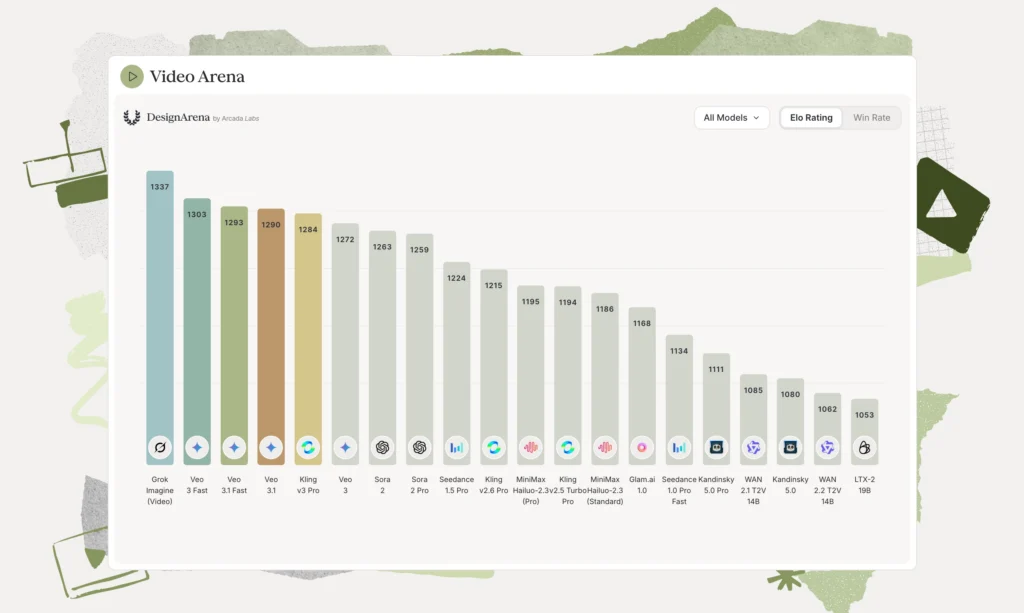
The AI video generation landscape is experiencing a massive shakeup. Recently, a leaderboard from Design Arena (by Arcada Labs) sent shockwaves through the AI community—even catching the attention of Elon Musk on X. The reason? xAI’s Grok Imagine secured the number one spot across three critical benchmarks, decisively beating industry heavyweights like Google Veo 3.1, Kling v3, and OpenAI Sora 2 Pro.
In this post, we’ll explore why Grok Imagine is dominating the charts, its game-changing features, and what this paradigm shift means for the future of AI video creation.
Table of Contents
Key Takeaways
- Triple-Crown Winner: Grok Imagine tops Design Arena’s blind-test leaderboards in Video Generation, Video Editing, and Image-to-Video.
- Unbeatable Cost Efficiency: At approximately $4.20/minute, Grok Imagine is significantly more affordable than Veo 3.1 ($12/min) and Sora 2 Pro ($30/min).
- Enhanced Core Capabilities: Version 1.0 brings cinematic motion smoothness, strict instruction adherence, and seamless native audio integration.
- Ready for Production: Already accessible via X, the xAI platform, and developer APIs.
The Design Arena Reality Check: Grok Imagine Takes the Crown
Unlike traditional AI leaderboards that often rely on isolated vendor self-testing and highly curated marketing demos, Design Arena operates similarly to the popular LMSYS Chatbot Arena. It utilizes a blind-test voting system where users rank generated outputs without knowing which underlying model produced them. The results are calculated using Elo ratings, offering a much closer reflection of real-world usability and human preference.
Grok Imagine didn’t just win a niche category; it swept three high-value battlegrounds simultaneously:
- Video Arena (Text-to-Video Generation)
- Video Editing Arena
- Image-to-Video Arena
This comprehensive victory signals a systematic edge across the entire video generation pipeline, rather than a lucky fluke in an isolated test.
3 Core Strengths of Grok Imagine 1.0
According to 2026 industry insights, the release of Grok Imagine 1.0 represents a massive leap forward. Here is where the model stands out:
1. Superior Motion Smoothness and Dynamic Stability
A common flaw in many generative AI video models is that while the initial static frames look spectacular, the illusion rapidly breaks down once movement begins. Grok Imagine 1.0 significantly improves motion fluidity and dynamic stability. It prevents the awkward character animations, morphing limbs, and unnatural camera transitions that typically disrupt the viewing experience.
2. Precise Instruction Following
The true test of a generative AI tool isn’t just its ability to produce a beautiful clip—it’s the ability to produce exactly what the user asked for. Grok Imagine excels at prompt adherence. Whether a creator is requesting specific camera angle shifts, localized content replacements, or complex style transfers, the model executes the instructions reliably. This makes it a highly viable tool for commercial content creation and automated enterprise workflows.
3. Native Audio Integration
The battle for AI video is no longer restricted to pixels. Grok Imagine natively integrates high-quality, synchronized audio with its video outputs. By combining motion and sound accurately, it moves one step closer to becoming a complete, ready-to-use content production engine.
The Real Disruptor: Pricing That Changes the Math
While topping leaderboards is impressive, Grok Imagine’s pricing model is what will truly disrupt the market. High-quality AI video generation has traditionally been cost-prohibitive, but xAI is aggressively lowering the barrier to entry.
Current Estimated Generation Costs (including audio):
- Grok Imagine: ~$4.20 per minute
- Google Veo 3.1: ~$12.00 per minute
- OpenAI Sora 2 Pro: ~$30.00 per minute
By slashing costs by up to 85% compared to premium competitors, Grok Imagine transforms top-tier AI video from an expensive laboratory luxury into a scalable daily tool for creators, marketers, and businesses.
Moving Beyond the Lab: Ecosystem and API Integration
Grok Imagine is already deeply integrated into real-world applications. It is not just a research preview; it is actively accessible via the Grok assistant on X (formerly Twitter) and the official xAI platform. Furthermore, xAI has opened API access for developers.
This multi-channel distribution strategy highlights xAI’s focus on productization. They are providing:
- Direct consumer access for everyday users.
- Developer-friendly APIs to build third-party applications.
- A massive platform ecosystem (X) for immediate content distribution.
Conclusion: A New Era for AI Video Generation
For a long time, the AI video sector seemed destined to be dominated by Sora, Veo, and Kling. However, Grok Imagine’s multi-dimensional success in generation quality, editing flexibility, cost-efficiency, and ecosystem integration proves that the market dynamics are shifting rapidly.
The competition in generative AI video is no longer just about “who can make the most breathtaking 10-second demo.” It is now about who can deliver the best combination of visual quality, operational cost, productization, and ecosystem synergy.
As we progress through 2026, the tool that truly democratizes high-quality video generation might not be Veo or Sora—it looks to be Grok Imagine.
Data Source: Rankings based on the Design Arena crowdsourced evaluation platform by Arcada Labs (https://www.designarena.ai/).